Trade Silver Dollar Public Education
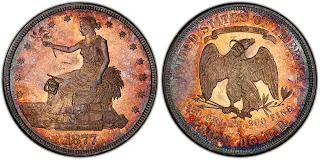
The Trade dollar was minted from 1873 to 1885. It was designed by William Barber and contains 0.7874 oz of silver with a weight of 27.22 grams. Many pieces were shipped to Asia in payment for trade. While in Asia, merchants often stamped one or more Chinese character marks on the coin to designate that it came from a specific business and was a good silver coin backed by the business. These became known as “chopmarks”. While the U.S. coin market initially devalued coins that were defaced with Chinese characters, trade silver dollar “chopmark” collectors and a club developed, with some coins now bringing premiums over common Trade dollars.
Key Trade Dollar Varieties
The key date in the Trade dollar series is the 1878-CC, with a mintage of 97,000. Other better dates include the 1873-CC with 124,500 mintage, and the 1875-P with 218,200 mintage. Several rare die varieties exist that command a premium. By far, the rarest is the 1876-S doubled die obverse, the strongest obverse doubling in the series. The 1876-CC doubled die reverse is scarce and is the strongest doubled die reverse in the series. A scarce 1875 S/CC over mintmark is known (listed in the Cherrypickers’ Guide to Rare die Varieties as FS #501 (after authors Bill Fivaz and J.T. Stanton), with a recently discovered, different 1875 S/CC variety (FS#502) that appears to be even rarer.
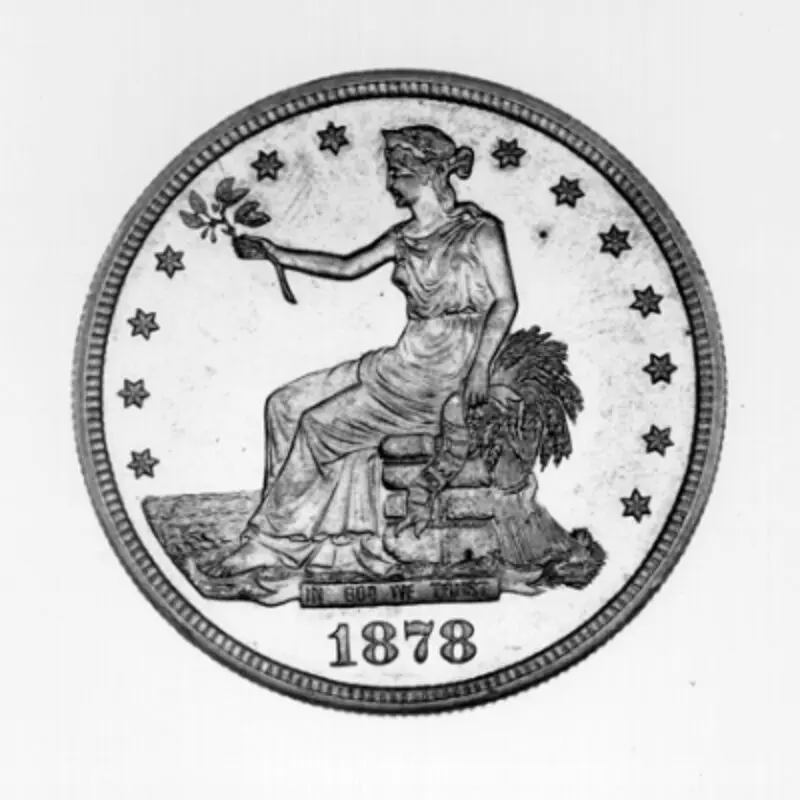
There are several different Trade dollar design types known and identified as follows:

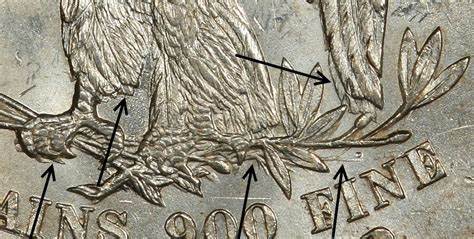
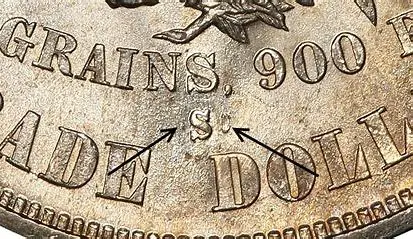
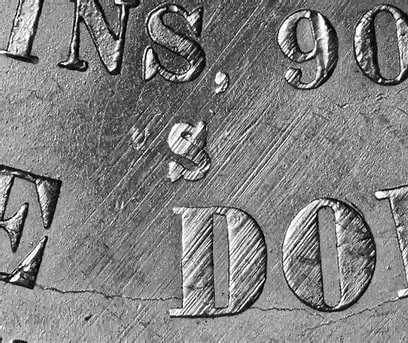
1875 S/CC Trade Dollar FS#501 (left-Photo courtesy of PCGS) 1875 S/CC Trade Dollar FS#502 (right)
Revising Trade Dollar Designations
In 2016, F. Michael “Skip” Fazarri discovered a new reverse for the 1877-S Trade dollar. The primary diagnostic points on the newly identified reverse hub are the absence of a berry below the eagle’s claw, along with the presence of split-tail back feathers on the eagle. However, Fazzari said, he was able to find evidence of type crossovers between the early and later dates, requiring further revisions to the type designations, to include a Type 2M obverse and 2M reverse. The 2M designations primarily occurred among coins struck in 1875, 1876 and 1877. (courtesy of Coin World, May 11, 2016)
Fazzari designated these as:
Valuable Trade Dollar Varieties
The various combinations of different types have led to rare die varieties that command a premium over common types. These include: An 1875-P Type I obverse and Type I reverse, an 1876-P Type II obverse and Type II reverse, and an 1875-CC Type I obverse and Type II reverse.
Proof Trade dollars from 1873 to 1885 should be certified by a reputable grading service. The earlier dates, prior to 1876, are valued in excess of $2500 in lower proof grades of Proof-60 and can increase to several thousand dollars or more in higher proof grades.
Two ultra-rare proof dates are the 1884 with a mintage of 10 coins and the 1885 with a mintage of only 5 coins. In 2019, an 1885 Proof-66 sold in a Heritage auction for $3.96 million dollars.
The population of Trade dollars at NGC is given at Trade Dollars (1873-1885) | Coin Census Population Report | NGC, while retail prices are given as Trade Dollars (1873-1885) | Price Guide & Values | NGC. The population of Trade dollars at PCGS is given at Trade Dollar - PCGS Population Report, while retail prices are given at PCGS as Trade Dollar (1873-1885) Values - PCGS Price Guide.
Trade dollars are normally collected by type, by date, by chopmark and by rare die variety, although the later can be cost prohibitive. A good online reference about Trade dollars chopmarked with Chinese characters is given at: A Guide to Collecting Chopmarked US Trade Dollars by Date and Variety
Certification and authentication by a reputable grading service or consultation with a reputable and knowledgeable dealer or numismatic specialist is highly recommended, especially for coins valued in the $300 range and higher.
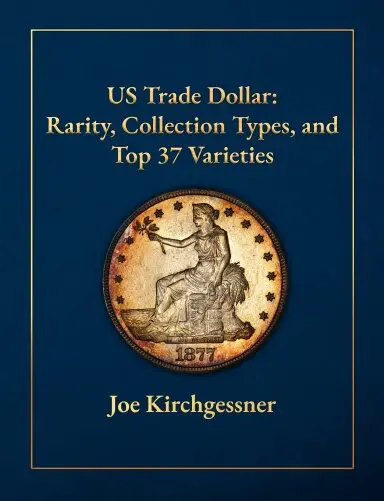
One of the best reference on Trade dollars and their varieties is given by Joe Kirchgessner in his 2025 reference at: www.lulu.com